Two Hoops, No Ticket Office: The Free Korfball Night That Makes January Feel Shorter
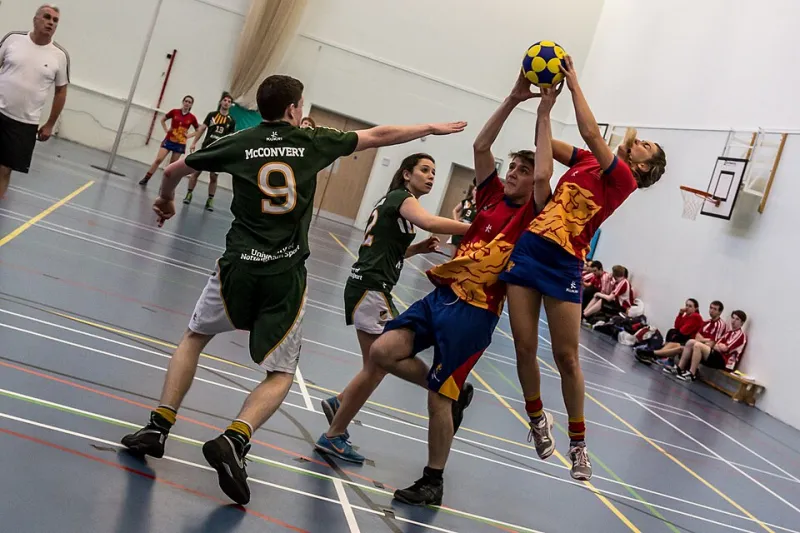
Photo: Peter Saxon, CC BY-SA 4.0, via Wikimedia Commons
There is a particular smell to a British sports hall in January: floor polish, radiator dust and the faint ghost of a hundred packed lunches. On a damp Tuesday night, with the rain hammering the leisure centre roof, that smell is oddly comforting. So is the sight of two teams warming up with a ball that looks familiar but is being used in a way that makes absolutely no sense to the uninitiated.
Welcome to korfball. It is fast, mixed-gender, played indoors and — at grassroots level — usually free to watch. No turnstile, no ticket app, no suspicious booking fee. Just a scoreboard, a tea urn and a sport that quietly rewards anyone willing to sit on a folding chair for an hour.
The Game That Refuses to Be Mysterious
Korfball has a reputation for being complicated, which is unfair. It is unfamiliar, not difficult. Invented in the Netherlands in 1902, it has been ticking along in British sports halls for decades without demanding a stadium or a television deal. The basic idea is simple: two teams, two hoops, one ball, and a rule book that can be explained during the warm-up.
Each team has eight players on court — four men and four women. The court is split into two halves, and each team puts two men and two women in each half. You cannot dribble, you cannot run with the ball, and you cannot simply barge someone out of the way. Shooting is only allowed from the attacking half, and a shot while closely defended is not allowed. The hoop is a bottomless basket on a post, with no backboard to thump satisfyingly.
That last detail changes everything. Without a backboard, every goal is a clean arc, a soft drop or a clever little bounce off the rim. It looks less like basketball and more like netball’s quicker, stranger cousin. The mixed-gender rule is not a gimmick either: teams have to find a balance between strength, speed and spatial sense. Defenders mark players of the same sex, which means the game constantly reshuffles its own match-ups.
You do not need to memorise the rule book to enjoy it. In fact, the best way to learn is to watch a few minutes, ask the person next to you why the referee blew up, and accept that the answer will make sense eventually.
Eight Players, Two Hoops and a Very Civilised Sort of Chaos
The first thing that strikes you at a grassroots korfball night is the noise. Not aggressive noise — more the squeak-and-shout soundtrack of any indoor sport played by people who actually know each other. Trainers chirp on the floor. Someone’s dad yells encouragement. A substitute rotates on and immediately gets involved. The ball moves quickly, but not frantically. Korfball rewards passing, pivoting and finding space, so the game has a rhythm that is easy to follow once you tune in.
Because there is no dribbling, there are no solo runs from one end to the other. That makes it a brilliant spectator sport for people who usually find basketball a bit stop-start. Every attack is a little puzzle: create a shooting chance, avoid a defended shot, keep the ball moving. The best teams make it look like a dance. The less experienced teams make it look like a very enthusiastic game of keep-ball, which is also entertaining.
There is also a built-in decency to the thing. Physical contact is limited, arguing with the referee is pointless and the mixed-gender format tends to produce a friendlier atmosphere than you might expect from a fast court game. That is not to say it is soft. A well-timed interception still gets a proper gasp. A last-second goal still gets a proper cheer. It just does not come with the chest-beating pantomime that sometimes follows other indoor sports.
What a League Night Actually Feels Like
A local korfball fixture is rarely a grand occasion. You might find it in a university sports hall, a community leisure centre or a school gym that smells faintly of disinfectant and ambition. Spectators line one wall on plastic chairs or benches. There is usually a table for the scorer, a coach or two muttering notes, and a cluster of players waiting to rotate on. Some clubs have a tea hatch. Some have a kettle and a tin of biscuits. The best ones have both.
This is not a corporate matchday experience. There is no mascot, no half-time entertainment and no queue for a £9 hot dog. What there is, instead, is access. You can hear the players talking to each other. You can see the tactics being shouted across the court. You can watch a team grow into a game over two halves and feel like you have seen something real rather than a product.
And because the sport is small in Britain, the crowd is often made up of friends, family, clubmates and a few curious locals. That makes it unusually easy to settle in. You will not be the only person who does not know the rules. You will not be surrounded by people who have paid £60 and expect a performance. You are just there, in a warm hall, watching people try hard at something they love.
Finding a Free Fixture Near You
Korfball in the UK is organised through clubs, university teams and regional leagues, and most grassroots fixtures are free to attend. The trick is knowing where to look. Start with club social media pages and local league websites, which often post fixtures and venue details a week or so in advance. University sports halls are a good bet during term time, especially if the university has a korfball club. Local leisure centres and community noticeboards sometimes advertise matches too, though they are less reliable than a club’s own channels.
If you cannot find a fixture listed, message a local club and ask. Korfball people tend to be the sort who reply with a venue, a start time and an offer to explain the rules over a cup of tea. Check whether spectators are welcome and whether there is any entry charge — grassroots usually means free, but it is polite to check rather than assume. Bring a bit of cash for the tea fund anyway. It is the unofficial admission fee.
Cheering Without Refereeing From the Bench
You do not need a deep tactical understanding to be a good korfball spectator. Clap the good pass. Gasp at the interception. Cheer the goal. Try not to shout instructions at players who are already being shouted at by their own coach. And please do not yell at the referee about a rule you learned from a thirty-second internet search on the bus.
The nice thing about korfball is that the crowd is usually close enough to the action to see the effort. You can appreciate a well-timed pivot even if you could not explain it afterwards. You can enjoy the way a team creates space without needing to know the name of the movement. And you can cheer both sides without feeling like a traitor, because the atmosphere is usually more village fete than derby day.
The Huddle Is the Point
After the final whistle, something happens that you do not always get at bigger sporting events. The teams huddle. Not in a staged, cameras-on-us sort of way — just a quick gathering, a few words, handshakes and then the slow drift towards bags, water bottles and the tea table. Players from both sides mix. Someone’s mate asks how the knee is. Someone else debates the last goal. The referee gets a quiet thank you.
That post-match huddle is why korfball works as a winter habit. It is a sport that understands belonging is part of the point. You can turn up on a cold Tuesday, watch a free match, learn a few names and leave feeling like you have been somewhere human. In 2026, with so much sport priced like a special occasion, that is worth a great deal more than the admission fee.
So next time January feels endless, find your nearest korfball hall. Take a friend, take a flask, take a willingness to be slightly confused for ten minutes. The rules will click. The tea will be hot. And the huddle will make you want to come back.