Concrete Courts, Open Run: Why Britain’s Best Basketball Crowd Has No Ticket Office
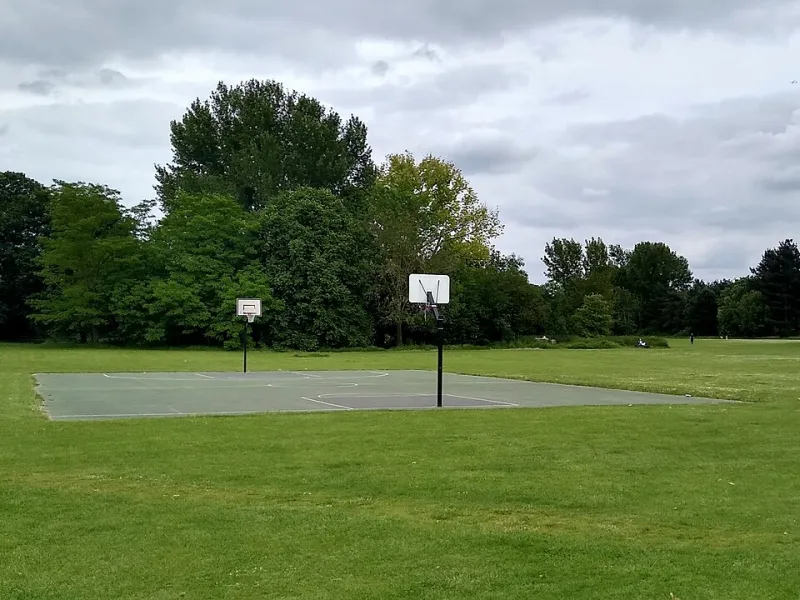
Photo: Mertbiol, CC0, via Wikimedia Commons
Basketball in Britain has a habit of being talked about in terms of what it lacks: arena space, television coverage, a permanent seat at the top table. All fair points. But walk past a park court on a warm evening and you will see something the spreadsheets keep missing. The game is already here, it is free, and the crowd is standing about three feet from the baseline.
That is the quiet argument for Britain’s outdoor basketball scene in 2026. While paid arenas offer polished product and a night out, the council court offers access. No ticket office, no dress code, no need to plan weeks ahead. You turn up, you watch, you might get a run. The fence is the turnstile, and it is open.
The court is the club
A good outdoor court does not need much: a flat surface, two hoops, lines that are roughly where they should be, and a net that has survived the wind. What it creates is a public square with a ball. Teenagers drill before school. Adults play five-a-side after work. Someone’s little brother practices free throws while pretending not to watch the older players. The standard can be excellent; the welcome can be even better.
This is not a romanticised version of grassroots sport. Some courts are tired. Some have broken rims, missing nets or lighting that gives up at dusk. Access is not equal across the country. But the principle matters: free outdoor basketball gives fans and players a place to belong without a paywall. In a sporting landscape that keeps asking people to subscribe, that is worth defending.
Pick-up is the purest fan culture
Watching pick-up basketball teaches you things a broadcast cannot. You hear the check ball, the call of ‘winner stays on’, the good-natured argument over whether that was a foul. You see the etiquette: call your own fouls, pass to the new person, do not hog the ball just because you can. You learn that a crowd can be noisy and respectful at the same time.
For fans, the fence is a brilliant place to start. You do not need a season ticket to understand the rhythm of the game. Stand at the side, watch a few runs, ask who is about to play next. If you are new, do not march onto the court mid-game and start launching shots. Watch first. Then ask. The outdoor game has its own code, and it is usually generous to anyone who respects it.
The tournament on your doorstep
Community-run tournaments are the outdoor scene’s best advert. Summer three-on-three events, council play days, church-hall leagues spilling outside, local clubs taking over park courts for a Saturday. They are free to watch, often free to enter, and they pull in exactly the kind of mixed crowd that paid sport sometimes struggles to reach: families, teenagers, students, older players who still fancy a game, and people who just heard the noise from the bus stop.
If you want to find one, start locally. Council leisure pages and parks departments list summer events. Basketball England’s club finder can point you towards organised sessions. Local clubs and community groups advertise on social media, and the most reliable source is usually word of mouth: ask at the court, ask at the leisure centre, ask the person carrying a basketball on the train. The 2026 outdoor calendar will not always be glossy, but it will be there.
Access is the headline
Here is the opinion bit. Free outdoor courts are not a nice extra. They are sporting infrastructure, as much as a running track or a playing field. They give young people somewhere to go that is not a shop or a screen. They let adults rediscover a game they gave up at school. They create local characters, local rivalries and local pride. A council that keeps a court playable is doing something quietly important.
That means the conversation should not stop at celebration. Nets need replacing. Surfaces need cleaning. Lighting needs to work. Bins need emptying. The users have a role too: respect the court, respect the neighbours, take your rubbish home. But the bigger ask is for the people with the keys to treat these spaces as worth maintaining. A free court is only truly free if it is safe and usable.
How to find your local court in 2026
Search your council’s parks and leisure pages, look at local club socials and ask in community groups. Visit at peak times if you want to watch or play, and at quieter times if you want to practise. Bring water, wear shoes you can move in and take a layer for when the sun drops. If you are spectating, keep off the playing area and keep your dog clear. If you are joining, introduce yourself and wait for the next run.
The best basketball crowd in Britain does not have a ticket office, a corporate lounge or a queue for the bar. It has a patch of concrete, a couple of hoops and a shared understanding that the game belongs to whoever turns up. In 2026, that is a fan community worth finding.